

Greater Tokyo

See & Do

reset
Moka Summer Festival “Kojin Festival”

Moka Summer Festival “Kojin Festival”

The "Moka Summer Festival," the largest event in Moka City, will be held for three days on late July. More than 20 portable shrines and floats gather together at the festival square, where you can feel the enthusiasm of the festival goers.   On the first day of the festival, "Degyo-matsuri," or the "departure from the shrine," is held at Omae Shrine.Many festival-goers participate in the Degyo-matsuri to pray for the safety of the procession of portable shrines and stalls, a good harvest, the eradication of disease, and the development of industry. After the Degyo-Dashi, "Machiawase" is held, in which the portable shrines are carried across each town council, and the head mikoshi parades through the city.   On the second day, "Festival Plaza" will be held and the city center will become a pedestrian zone. approximately 20,000 fireworks will color the night sky, and "Mikoshi Kawatogo (carried mikoshi to cross the river)" would be held on Gogyo River.

Oshu kaido Nikko kaido TOCHIGI
Nasu Yuzen Shrine

Nasu Yuzen Shrine

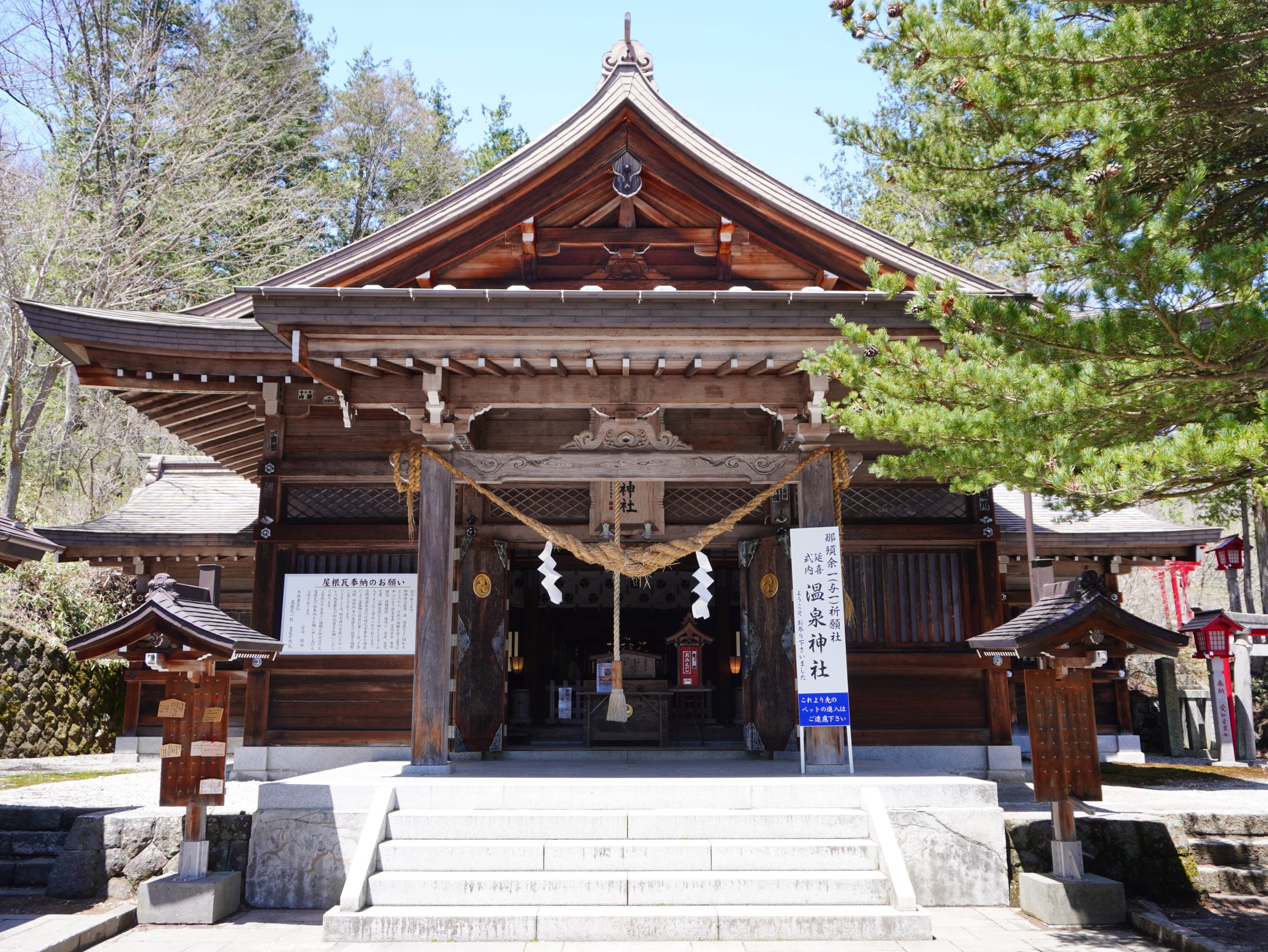
History of Nasu Yuzen Shrine It is said that a hunter named Kano found onsen here when he was trying to hunt a white deer. He built this shrine for thanksgiving. According to an article written in Nara period (A.D 710~794), we can confirm that the shrine already existed during that time.   During the Genpei War in 12th century, an archer called Nasu Yoichi came here to pray for victory over Taira family’s army. He shot down a fan by one arrow that enemy put on the front of their boat when he stood on the ground. It made him became legend and the shrine became very famous for blessing Yoichi. Yoichi donated his bow and arrow to the shrine, which became shrine’s tressure later.   Shrine’s famous festival The most important event of the shrine is the “Dai Festival”, which is held on October 8 and 9 every year. They dedicate onsen to the God, and perform a traditional dance called “Urayasu Dance”.   Then on October 9, people perform another traditional dance called “Ozawa’s Lion Dance,” which is designated as the “Intangible Cultural Property of Nasu Machi” to pray for prosperity.   There is also a famous festival be held on the last weekend of May, the “Nasu Seshosseki Gojinka Festival”. The highlight of the festival is a parade from Yuzen Shrine to Sesshoseki by participants attired in white clothing with torches.

Nikko kaido Oshu kaido TOCHIGI
The Great Wisteria Festival of Ashikaga Flower Park

The Great Wisteria Festival of Ashikaga Flower Park

Ashikaga Flower Park was the only spot in Japan that had been selected as “top 10 world Dream destinations” by CNN. The garden holds “The Great Wisteria Festival” from late April to mid-May every year. You can see the Great wisteria over 160 years old which spreads over a 600-tatami trellis area, as well as the 80m-long white wisteria tunnel, the Laburnum tunnel and more than 350 other wisteria trees in full bloom. Various colors of wisteria bloom in order, from pale pink, purple, white, to yellow, which allows you to enjoy all of the wisteria for about one full month. You also can enjoy wisteria in night because the garden would be lighted up during the festival. In 2018, the JR Railway opened JR Ashikaga Flower Park Station, which make visitors to come here easily.

Nikko kaido Oshu kaido TOCHIGI
THE RITZ-CARLTON, NIKKO

THE RITZ-CARLTON, NIKKO

The Ritz-Carlton, Nikko, the luxury hotel in Nikko National Park, is the first Ritz-Carlton where guests can enjoy a hot spring. Baths source hot spring water from the historic Nikko Yumoto Onsen. Its soft, milky warm water makes you feel the blessing of the nature of Okunikko. Each suite features a private balcony from which you can enjoy the view of scenic Lake Chuzenji and majestic Mount Nantai, both of which are the symbols of Nikko National Park. You will be sure to lose track of time in these spacious guest rooms, which come with a traditional engawa porch and the décor that blends minimalist and traditional Japanese styles together. For dinner, you can have a traditional multi-course kaiseki meal prepared with fresh ingredients produced in Tochigi Prefecture for you to explore the intricate world of Japanese cuisine. The hotel, being amid the grand nature of Nikko, also offers activity programs including hiking and skiing. 【About the hot spring】 Water color: milky white Spring water type: hydrogen sulfide-type simple sulfur spring water Efficacy: alleviates nerve pain, joint pain, and fatigue, and boosts skin metabolism by removing substances causing atopy Note: people wearing a fashion tattoo are permitted
Nikko kaido Oshu kaido TOCHIGI
Komadome Falls

Komadome Falls

Considered Nasu's foremost waterfall, Komadome Falls is three meters wide and falls approximately twenty meters from a cliff on the Yosasa River. Once, it was a waterfall that can only be seen after the leaves have fallen, but along with the establishment of Nasu Heisei no Mori Forest in 2011, as well as a falls observatory, it became possible to catch a glimpse of Komagome Falls throught the seasons (closed during winter). The observation deck allows you to see a full view of the waterfall from above, which is surrounded by emerald green trees in the early summer and a rainbow of colorful leaves in the fall. Around the end of October, when the autumn leaves are at their peak, the contrast of red and yellow in the valleys together with the clear blue of the waterfalls is a spectacular sight for visitors."

Nikko kaido Oshu kaido TOCHIGI
Tobu Chuzenjiko Cruise

Tobu Chuzenjiko Cruise

Lake Chuzenji is located in the area leading into Okunikko. It has a circumference of 25 km and the water reaches a depth of 163 m. It is said that lava from the eruption of Mount Nantai 20,000 years ago blocked the valley to create the initial form of the lake. Because of the spectacular view in each season, the lakeside area used to be a popular summer retreat for foreigners. That areas still features the Italian Embassy Villa Memorial Park and British Embassy Villa Memorial Park. The pleasure boat of the Tobu Chuzenjiko Cruise sails through the beautiful scenery and near these tourist destinations. In fall, you can see mountains covered in explosions of red, orange, and yellow from the lake. It is truly a picturesque view. The tour takes about 55 minutes in total, but there are tickets available for visitors to get on/off along the course.

Nikko kaido Oshu kaido TOCHIGI
Saimyoji Temple

Saimyoji Temple

This Shingon Buddhist Sect Buzan School Temple in Mashiko City, Tochigi Prefecture is dedicated to the 11-headed Kanzeon Bodhisattva.  Saimyoji temple is the twentieth temple in the Bando (33 Kannon temples of kanto region) pilgrimage circuit. The gabled thatched two-story gate and three-story pagoda constructed in 1492 and the miniature shine in the main temple hall that is said to be created during the Muromachi period have all been designated Important Cultural Properties of Japan. A statue of a laughing Yama (king of Hell) next to the Bodhisattva Jizo who protects those who have fallen to hell is also found here at the temple. The laughing Yama (king of Hell) is said to be the incarnation of the jizo."

Nikko kaido Oshu kaido TOCHIGI
Tochigi Flower Center

Tochigi Flower Center

The Tochigi Flower Center is located at the base of Mt. Mikamosan Park. Come enjoy a variety of flowers in a large flower bed shaped like six flower petals as well as the largest greenhouse in the country. The center plans a variety of exhibitions based on the season and also offers horticultural advice. Their permanent exhibits include flowers, fruits, and plants of the tropics and subtropics as well as strange, bizarre, and rare plants from around the world such as welwitschia mirabilis. Events are held showing off seasonal flowers."

Nikko kaido Oshu kaido TOCHIGI
Torinoko Sansho Shrine

Torinoko Sansho Shrine

Torinoko Sansho Shrine consists of a main hall, a worship hall, a tower gate, a Torii gate (at the prefectural border of Tochigi and Ibaraki) and the main shrine. The shrine is known for its lucky owl, a messenger from the god who brings good luck. The temple complex contains the nation’s largest statue of an owl, an owl post, an owl bell and an owl statue on which visitors pour water to wash their troubles away. Other notable sites include a miraculous turtle well that has never dried up and the building known as Gochiin where famous feudal lord Mitsukuni Tokugawa once stayed.

Nikko kaido Oshu kaido TOCHIGI
Yatai-no-Machi Central Park

Yatai-no-Machi Central Park

Yatai-no-Machi Central Park is home to the Yatai Museum, Tourism and Local Products Centre and “Kikusuien”, one of three famous gardens in Kanuma. The Yatai Museum’s exhibits include three hand-carved wooden floats – official local cultural properties – and videos on the Kanuma Autumn Festival which is designated an Important Folk Cultural Property. Take a close look at elaborate carvings on the floats and learn about the history of this famous festival. Built in the early 1900s, “Kikusuien” was known as one of three outstanding gardens in Kanuma at that time. Many cultural elites such as Sumio Kawakami (a printmaker) visited and loved this Japanese garden. Nowadays many people come to the restored garden for its fantastic autumn leaves in late November. The Tourism and Local Products Centre is a hub for tourism offering a selection of brochures about destinations in Kanuma in addition to a wide range of local products. At the Konjac café, visitors can enjoy a variety of dishes hand made from the local all-natural Konjac potatoes.

Nikko kaido Oshu kaido TOCHIGI
Kashi-no-Mori Park

Kashi-no-Mori Park

Kashi-no-Mori Park is an oasis for both children and adults throughout the year and is easily accessible by car. A wide range of events are held in the park in early April when visitors come for the “Sakura Festival” in spring. The park is also popular for a fantastic night time viewing of illuminated cherry blossoms. The streets around Kashi-no-Mori Park are lined with cherry blossom trees (north-south 2.3km, east-west 1.3km). Be sure to walk through the stunning cherry blossom tunnelled street with approximately 650 Yoshino cherry trees!

Nikko kaido Oshu kaido TOCHIGI
Ashio Copper Mine

Ashio Copper Mine

With a 400-year history, Ashio Copper Mine is a tourist attraction built out of the industrial remains of what used to be the largest copper mine in Japan. A trolley train transports visitors 700 metres underground to displays of the mine’s chronology and history and demonstrations of the harsh working conditions through life-like wax figures. You can learn more about this industrial property at the three on-site museums including the copper museum with displays of traditional copper processing methods. Then relax at the traditional cafe or enjoy a leisurely walk along the nearby Watarase River. Between 1610 and 1868, the copper mined here was an important resource for the prosperity of the nation. It was used to produce tiles for castles and shrines and was exported to China and the Netherlands. Among the coins of the years 1600 to 1867, coins produced in Ashio were known as “Ashiji-sen” with the Chinese character of “Ashi (foot)” on the back. Today the coin-shaped local Japanese sweet “Ashiji-sen Monaka” is a popular souvenir.

Nikko kaido Oshu kaido TOCHIGI
Chuzenji Onsen

Chuzenji Onsen

This Onsen town on the northern shore of Lake Chuzenji, situated 1,250 metres above sea level.The town is popular as a summer resort and as a place of scenic beauty for autumn leaves. Chuzenji Onsen is drawn from Nikko Yumoto Onsen, 12 kilometers away. At Yumoto Onsen the water is 78° C, but it cools down to a more comfortable temperature by the time it reaches Chuzenji Onsen.The town is close to the Kegon falls and offers beautiful seasonal scenery.

Nikko kaido Oshu kaido TOCHIGI
Nasu Heisei-no-Mori Forest

Nasu Heisei-no-Mori Forest

Nasu Heisei no Mori is a forest park that was originally part of nearby Nasu Imperial Villa. The forest opened to the public in 2011 as part of Nikko National Park. Nasu Heisei-no-Mori Forest consists of two areas: the Forest Recreation Zone and the Forest Learning Zone. You can stroll freely through the forest. There are three loop trails in the Recreation Zone. The longest, about 3 kilometers, leads to the Komadome Waterfall Observation Deck. At Nasu’s Komadome Waterfall, the scene created by the dynamic, seasonal landscape of the mountains and the contrast of the waterfall’s stunningly clear, blue water is simply breathtaking. In contrary, entering the "Forest Learning Zone" is limited to people with guide reservations in advance, but is definitely a valuable experience, since a guide will walk you through the forest while providing you interesting knowledge about the surrounding nature. During the winter months when the Forest Learning Zone is closed to the public, the Field Center offers guided snowshoe walks through the Recreation Zone.

Nikko kaido Oshu kaido TOCHIGI